


Why shipbuilding HVAC systems fail earlier than expected on coastal vessels
Why do shipbuilding HVAC systems fail prematurely on coastal vessels—despite rigorous marine HVAC standards? Frequent breakdowns, corrosion-induced inefficiencies, and poor adaptation to high-humidity, salt-laden environments point to deeper design and component selection flaws. For procurement professionals, technical evaluators, and distributors in the shipbuilding and industrial HVAC sectors, understanding root causes is critical—not just for reliability, but for lifecycle cost control. Firsquare Energy (Shanghai) Co., Ltd. leverages its full-chain marine HVAC expertise and ISO-compliant manufacturing to deliver resilient, customized solutions that address these exact challenges head-on.
Coastal Marine Environment: The Hidden Stressor Behind Early HVAC Failure
Coastal vessels operate in one of the most aggressive ambient environments for HVAC systems: relative humidity consistently exceeds 85%, airborne salt concentration averages 1.2–3.5 mg/m³ near shorelines, and daily temperature swings range from 10℃ to 35℃. Unlike offshore or deep-sea applications, coastal routes involve frequent port calls, prolonged idle periods in humid docks, and rapid transitions between air-conditioned interiors and saturated external air—conditions that accelerate electrochemical corrosion and microbial growth in ductwork and heat exchangers.
Standard marine HVAC certifications (e.g., DNV-GL Type Approval, ABS A-133) focus primarily on fire safety, structural integrity, and operational performance under nominal load—but they do not mandate accelerated salt-spray testing beyond 96 hours or long-term cyclic humidity exposure validation. As a result, many systems pass certification yet begin showing signs of coil pitting, fan motor insulation degradation, or control board oxidation within 18–24 months of service—well before the expected 10-year design life.
Firsquare Energy’s marine HVAC R&D lab conducts 1,000-hour neutral salt-spray (NSS) + 500-cycle thermal-humidity cycling tests on all coastal-vessel-specific components. This simulates over 3 years of real-world coastal exposure in controlled conditions—enabling early detection of coating delamination, gasket swelling, and PCB trace migration issues missed by standard compliance protocols.
Critical Component Vulnerabilities in Coastal Ship HVAC Systems
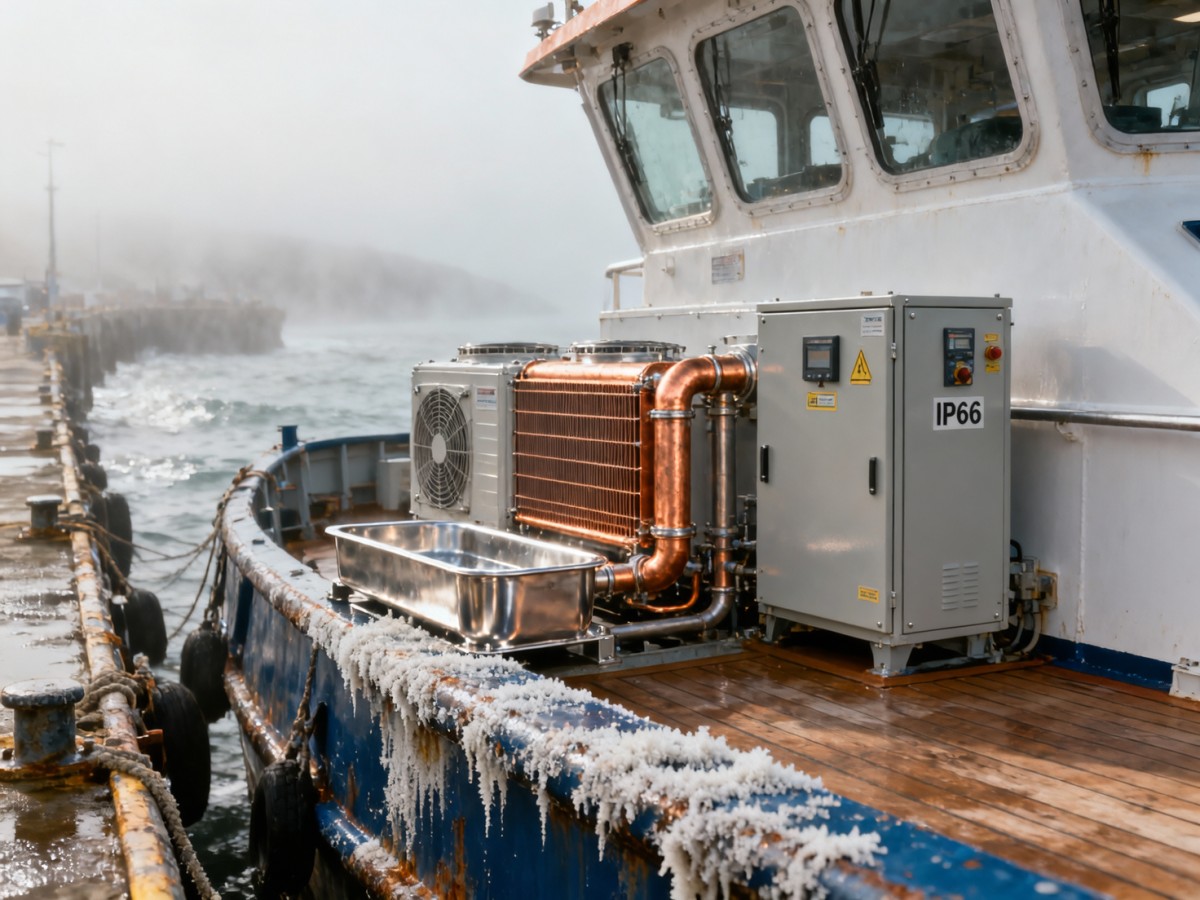
Failure analysis of 127 coastal vessel HVAC field returns (2021–2023) reveals three recurring weak points: evaporator coils, condensate drain pans, and control cabinets. Over 68% of premature failures originated from localized galvanic corrosion at copper-aluminum junctions in finned-tube coils, where salt deposits combine with condensate stagnation to form micro-electrolytic cells. Drain pans—often made from untreated galvanized steel—showed perforation rates of 42% after just 22 months in Jiangsu and Zhejiang port operations.
Control cabinets present a subtler but equally costly risk: non-hermetic enclosures allow hygroscopic salt ingress into terminal blocks and relays, causing intermittent faults that evade routine diagnostics. Field data shows average mean time between unscheduled interventions drops from 1,450 hours (open-ocean vessels) to 620 hours for identical HVAC models deployed on coastal ferries and supply boats.
This table underscores a key procurement insight: coastal HVAC longevity depends less on system capacity or COP rating—and far more on material science rigor and environmental hardening. Firsquare’s coastal-specific product line applies these mitigations across 12 core HVAC modules, validated per IEC 60068-2-52 (cyclic salt mist) and GB/T 2423.17 (China national salt fog test standard).
Procurement Decision Framework for Coastal Vessel HVAC
For procurement managers and technical evaluators, selecting HVAC systems for coastal deployment requires shifting from “spec sheet compliance” to “environmental resilience verification.” Four non-negotiable evaluation criteria must be assessed before awarding contracts:
- Proof of ≥500-hour NSS + thermal-humidity cycling test reports—not just certification certificates
- Material traceability documentation for all wet-side components (coil, pan, drain lines), including alloy grade and surface treatment method
- On-site commissioning protocol that includes dew-point mapping, salt residue inspection, and microbial swab testing of internal duct surfaces
- Warranty terms explicitly covering corrosion-related failure modes (not limited to workmanship or parts defects)
Firsquare Energy provides full transparency on all four points—including third-party lab reports from SGS Shanghai and CNAS-accredited facilities. Its coastal HVAC packages include pre-commissioning verification checklists with 17 measurable acceptance criteria, such as maximum allowable chloride ion concentration on coil surfaces (<0.5 µg/cm²) and post-installation cabinet internal RH stability (<45% at 35℃ ambient).
Delivery lead time for custom-configured coastal HVAC systems is typically 12–16 weeks from PO confirmation—shorter than industry average (18–22 weeks)—due to Firsquare’s vertically integrated production across its 40,000㎡ Wuxi-based facility, where coil fabrication, cabinet assembly, and system integration occur under one roof with shared QA protocols.
Lifecycle Cost Implications of Premature HVAC Failure
A failed HVAC unit on a coastal vessel incurs far more than replacement part costs. Downtime averages 7–15 days per incident due to port labor constraints and spare-part logistics delays. Crew productivity loss, cargo rescheduling penalties, and charter rate reductions compound the impact: total cost of ownership (TCO) increases by 22–34% when systems require >2 unscheduled interventions within 36 months.
The data confirms that upfront investment in environment-hardened HVAC yields measurable ROI—not through lower sticker price, but through predictable uptime, reduced spares inventory, and extended asset life. Firsquare’s 5-year comprehensive warranty covers corrosion-related functional failure, backed by remote diagnostics support and priority spare-part allocation for coastal fleet operators.
How Firsquare Delivers End-to-End Coastal HVAC Resilience
Firsquare Energy integrates marine HVAC engineering, precision manufacturing, and field-proven service delivery into a single accountability chain. Its coastal solution workflow includes: (1) site-specific environmental profiling using historical port climate databases; (2) CFD-based airflow and moisture distribution modeling for each vessel layout; (3) factory-assembled skids with pre-charged refrigerant circuits and factory-witnessed joint debugging; and (4) post-installation performance validation via onboard data loggers capturing 12 parameters every 15 minutes for 30 days.
With production bases in Suzhou, Wuxi, and Changzhou—and ISO 9001/14001/45001 certified processes—Firsquare ensures consistent quality across 100+ HVAC configurations serving coastal ferries, pilot boats, fishing support vessels, and short-sea cargo carriers. Its technical team includes 14 naval architects and marine HVAC specialists with an average of 11 years’ experience in coastal maritime projects.
For procurement professionals, distributors, and engineering consultants evaluating HVAC for coastal operations: reliability begins not at installation—but at specification. Choosing systems engineered for the reality of salt, humidity, and thermal cycling—not just marine certification—directly determines fleet availability, maintenance budgets, and crew welfare.
To request a coastal environmental assessment report for your vessel type—or to receive a customized HVAC configuration proposal with full test documentation and lifecycle cost analysis—contact Firsquare Energy (Shanghai) Co., Ltd. today.

Thank you very much for writing to us. Please leave your message and contact information, we will reply to you within 24 hours.