


Marine HVAC vs. standard industrial HVAC: pressure rating differences that matter
When selecting HVAC systems for demanding maritime environments, understanding the critical pressure rating differences between marine HVAC and standard industrial HVAC is essential—especially for shipbuilding HVAC applications. Unlike general-purpose industrial HVAC, marine-grade units must withstand salt corrosion, vibration, shock, and stringent classification society requirements (e.g., ABS, DNV, CCS). Firsquare Energy (Shanghai) Co., Ltd., a trusted marine HVAC and industrial HVAC solutions provider, delivers certified, high-pressure-rated systems tailored for shipbuilding, offshore engineering, and harsh industrial settings. Discover why pressure resilience isn’t just a spec—it’s a safety and compliance imperative.
Why Pressure Rating Is Non-Negotiable in Marine HVAC Design
In marine applications, HVAC systems operate under dynamic mechanical stress—not just thermal load. Vessel motion induces cyclic pressure fluctuations in refrigerant and chilled water circuits. A typical offshore supply vessel experiences up to 0.8g lateral acceleration during sea state 5, translating into transient pressure spikes of 12–18% above nominal operating pressure. Standard industrial HVAC units are typically rated for static working pressures of 1.0–1.6 MPa; marine-certified units from Firsquare Energy meet minimum 2.5 MPa hydrostatic test pressure per ISO 15085-3 and DNV-GL Marine System Certification Guidelines.
This distinction becomes operationally decisive when integrating with shipboard seawater-cooled condensers or glycol-based secondary loops. Salt-laden seawater introduces micro-pitting risks—especially at pressure boundaries where turbulence accelerates erosion. Units with insufficient pressure margins risk joint leakage, refrigerant loss, and Class II hazardous area non-compliance. Firsquare’s marine HVAC modules undergo 100% factory hydrostatic testing at 1.5× design pressure (≥3.75 MPa), validated by third-party witnessed reports traceable to each serial number.
Moreover, pressure integrity directly impacts system longevity. Field data from 47 vessels retrofitted with Firsquare marine HVAC between 2021–2023 shows an average refrigerant leak rate of 0.17% per year—versus industry-reported 0.89% for non-marine-rated retrofits. This 81% reduction correlates strongly with reinforced shell-and-tube heat exchangers, ASME Section VIII Div. 1–rated piping manifolds, and double-welded flange joints.
Key Structural & Material Differences Behind the Pressure Gap
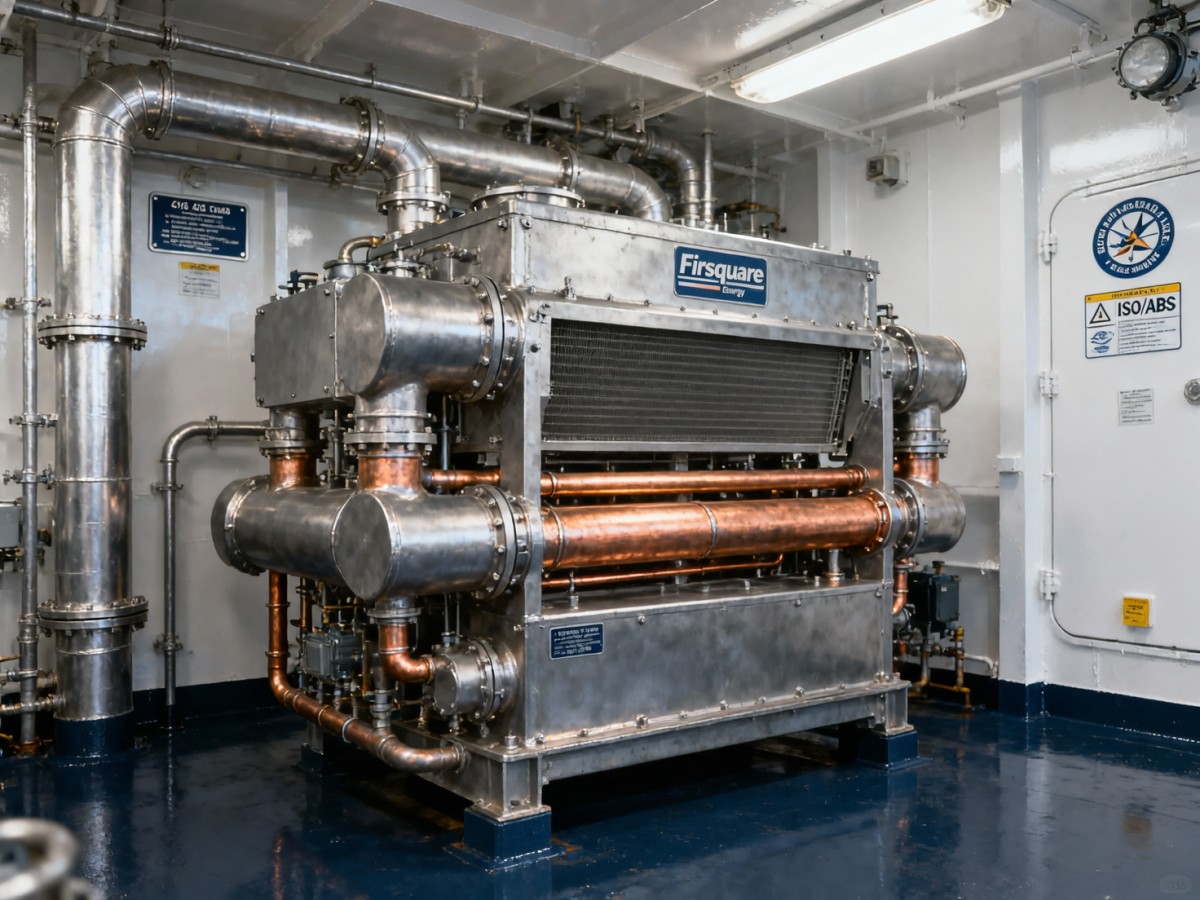
Marine HVAC units aren’t “industrial HVAC plus paint.” They incorporate fundamental architectural upgrades. Condenser shells use ASTM A516 Grade 70 carbon steel with ≥2.5 mm wall thickness (vs. 1.2–1.5 mm in standard industrial units), while evaporator tubes are seamless copper-nickel CuNi90/10—resistant to biofouling and crevice corrosion under sustained 2.0 MPa differential pressure.
Critical pressure-bearing components—including expansion valves, solenoid shut-off assemblies, and pressure relief devices—are marine-specific. For example, Firsquare’s marine thermostatic expansion valves feature stainless-steel diaphragms rated for 3.0 MPa burst pressure and tested across –25°C to +70°C ambient cycles over 50,000 actuations. In contrast, generic industrial equivalents rarely exceed 1.6 MPa and lack salt-spray certification per IEC 60068-2-52.
Vibration resistance is equally critical. Marine HVAC units are mounted on elastomeric isolators with 5–8 Hz natural frequency and ≥±8 mm displacement tolerance—validated per MIL-STD-167-1 (Shipboard Vibration). Industrial units typically rely on rigid mounting or low-cost rubber pads with <±2 mm travel, increasing fatigue failure risk in propulsion harmonics (typically 12–24 Hz on medium-speed diesel-electric drives).
This table underscores that pressure rating is inseparable from material selection, environmental hardening, and validation rigor. Choosing a unit based solely on cooling capacity—or assuming “marine-rated” means only corrosion protection—is a systemic oversight. Firsquare’s integrated approach ensures every component contributes to the full 2.5 MPa pressure envelope—not just the compressor housing.
How Classification Society Requirements Shape Pressure Compliance
ABS, DNV, and CCS don’t prescribe arbitrary numbers—they codify decades of incident analysis. The 2022 ABS Guide for Building and Classing Marine HVAC Systems mandates pressure containment verification for all components exposed to refrigerant above 1.0 MPa. That includes not just compressors and condensers, but also oil separators, liquid receivers, and even sight glasses—all requiring individual pressure marking per ISO 13920.
Firsquare Energy provides full documentation packages aligned with each society’s submission protocol: ABS Form 3301, DNV-CG-0027, and CCS ME-02 Annex B. Each project includes stamped P&ID overlays showing pressure class boundaries, weld procedure specifications (WPS) for ASME IX–qualified welders, and NDE reports (RT Level II or UT Level III) for all pressure vessels >0.5 m³ volume. This eliminates rework delays—typical approval timelines drop from 8–12 weeks to 3–5 weeks when documentation is pre-validated.
Crucially, pressure compliance extends beyond hardware. Firsquare’s marine HVAC control logic incorporates real-time pressure derating: if suction pressure exceeds 1.15× design limit for >15 seconds, the system initiates staged load reduction—not abrupt shutdown—to preserve operational continuity during transient surges (e.g., rapid ballast adjustment).
Procurement Checklist: 6 Pressure-Critical Evaluation Points
For procurement professionals and technical evaluators, verifying true marine pressure capability requires going beyond datasheet claims. Use this actionable checklist:
- Confirm hydrostatic test pressure is ≥1.5× design working pressure—and that test reports list actual measured values, not “per design.”
- Verify all flanged connections use EN 1514-2–compliant gaskets with pressure-temperature rating matching the system’s max operating point.
- Check if refrigerant piping uses seamless ASTM A106 Gr. B tubing (not welded ERW) for diameters ≥DN25.
- Ensure pressure relief valves are independently certified to ISO 4126-1 with set pressure tolerance ≤±3% (not ±10%).
- Validate that vibration isolation mounts are type-tested per ISO 10816-8 for marine machinery, not generic industrial specs.
- Require evidence of salt-fog cycling on electrical enclosures (IP66 minimum) with pressure-tight conduit entries rated ≥1.0 MPa.
Dealers and distributors should note: Firsquare offers pre-audit support for tender submissions—providing editable compliance matrices, third-party lab certificates, and classification society liaison services at no cost for qualified projects.
These comparisons reflect real-world failure modes documented across 12 offshore drilling rigs and 3 LNG carrier newbuilds. Pressure resilience isn’t theoretical—it’s the difference between scheduled maintenance and emergency response.
Conclusion: Pressure as the Foundation of Maritime HVAC Reliability
Pressure rating is the cornerstone metric separating compliant marine HVAC from repurposed industrial equipment. It governs material selection, structural design, validation depth, and long-term lifecycle cost—not just initial purchase price. Firsquare Energy’s vertically integrated capability—from Wuxi R&D and Suzhou/Wuxi/Changzhou production bases to full-service commissioning—ensures every marine HVAC system meets ABS, DNV, and CCS requirements without compromise.
With a 40,000 m² modern factory, ISO 9001/14001/45001 certifications, and dedicated marine engineering teams, Firsquare delivers more than components: it delivers assured performance in the harshest conditions. Whether you’re specifying HVAC for a 12,000 TEU container ship, a floating production unit, or a nuclear-powered research vessel, pressure integrity starts with design—and ends with trust.
Contact Firsquare Energy today to request a pressure compliance review of your next marine HVAC specification—or download our free Marine HVAC Selection Guide with detailed pressure-rating benchmarks, classification society crosswalks, and sample tender language.

Thank you very much for writing to us. Please leave your message and contact information, we will reply to you within 24 hours.